

MOAMEL ABDULJABBAR M.HUSSEIN
Assist. Prof. Rehab Jasim Mohammed
Assist. Prof.Mahmoud Aziz Mohammad
College of Education for Pure Sciences – Department of Chemistry
Form 2 diabetic melliitus (T2DM) is a prevalent, chronic, progressive, and heterogeneous condition marked by insulin resistivity and beta cells dysfunctions, leading to the inability to control increased blood glucose levels [1].
Form 2 diabetes affective approximately 30 millions people in the USA and more than 500 million people world, together approximately 1.5 million new cases in the United States each annual [2, 3]. Most of the health and economic burden is due to complications of the disease, such as retinopathy, nephropathy, and neuropathy, as well as a two- to five-fold increased risk of cardiovascular disease compared with people without diabetes [4].
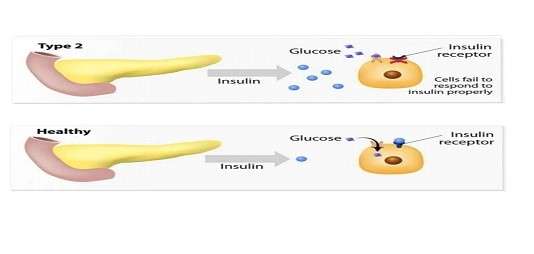
Figure 1The diference between insulin receptors in anormal person and a T2DM
Factors that influence type 2 diabetes
Type 2 diabetes is the result of an interaction of several factors including lifestyle, health status, genetics, psychosocial aspects, and demographic characteristics. These factors include high blood uric acid levels, problems with sleep quality and quantity, smoking, depression, cardiovascular disease, blood lipid disorders, high blood pressure, advanced age, race, family history of diabetes, in addition to physical inactivity and obesity [5].
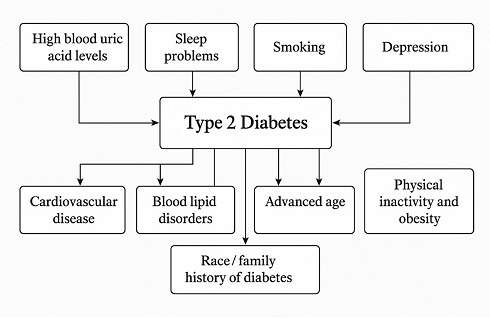
Figure 2factors effect in a T2DM
Prevention methods
There is no definitive cure for diabetes, so patients rely on a combination of healthy lifestyle and appropriate medications. This includes losing weight by 7%, taking into account ethnicity, increasing moderate physical activity to at least 150 minutes per week, and increasing dietary fibers capacity [6].
Interventions include individual or group nutritional and physical counseling by healthcare professionals, group education programs, and adapting diets and physical activity plans to patients’ needs [7]. Effective behavior modification approaches include encouraging patients to adopt new habits, helping them set health goals, providing information about the impact of current habits on their health, and using follow-up and reminder strategies to promote adherence to desired changes [8].

This video is about type 2 diabetes and how pancreatic beta cells deal with insulin.
References
[1] C. Prevention, “National diabetes statistics report,” Atlanta, GA: Centers for Disease Control and Prevention, US Department of Health and Human Services, 2020.
[2] H. Wang et al., “IDF diabetes atlas: estimation of global and regional gestational diabetes mellitus prevalence for 2021 by International Association of Diabetes in Pregnancy Study Group’s Criteria,” Diabetes research and clinical practice, vol. 183, p. 109050, 2022.
[3] A. D. Association, “Economic costs of diabetes in the US in 2017,” Diabetes Care, vol. 41, no. 5, pp. 917-928, 2018.
[4] M. J. Davies et al., “Management of hyperglycemia in type 2 diabetes, 2018. A consensus report by the American Diabetes Association (ADA) and the European Association for the Study of Diabetes (EASD),” Diabetes care, vol. 41, no. 12, p. 2669, 2018.
[5] E. M. Balk, A. Earley, G. Raman, E. A. Avendano, A. G. Pittas, and P. L. Remington, “Combined diet and physical activity promotion programs to prevent type 2 diabetes among persons at increased risk: a systematic review for the Community Preventive Services Task Force,” Annals of internal medicine, vol. 163, no. 6, pp. 437-451, 2015.
[6] M. Cardona-Morrell, L. Rychetnik, S. L. Morrell, P. T. Espinel, and A. Bauman, “Reduction of diabetes risk in routine clinical practice: are physical activity and nutrition interventions feasible and are the outcomes from reference trials replicable? A systematic review and meta-analysis,” BMC public health, vol. 10, pp. 1-17, 2010.
[7] N. T. Artinian et al., “Interventions to promote physical activity and dietary lifestyle changes for cardiovascular risk factor reduction in adults: a scientific statement from the American Heart Association,” Circulation, vol. 122, no. 4, pp. 406-441, 2010.
[8] A. Sanchez, P. Bully, C. Martinez, and G. Grandes, “Effectiveness of physical activity promotion interventions in primary care: a review of reviews,” Preventive medicine, vol. 76, pp. S56-S67, 2015.
Keyword; type2diabetes , isulin , betacell
Type 2 diabetes mellitus (T2DM)