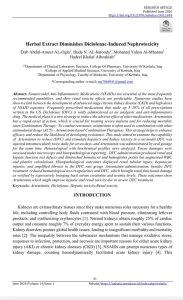

A team research from College of Pharmacy, University of Kerbala published a study entitled “Herbal Extract Diminishes Diclofenac-Induced Nephrotoxicity”.
The paper has been coauthored by Etab Abdul-Ameer AL-Ogla_ Department of clinical laboratory sciences, College of pharmacy, University of Kerbala Huda N. AL-baroody_ College of Applied Medical Sciences, University of Kerbala, Mohanad Yahya Al-Mhanna, Department of physiology, Faculty of medicine, University of Kerbala and Hadeel Khalaf Alboaklah, Department of clinical laboratory sciences, College of pharmacy, University of Kerbala.
It focuses on effectiveness of artemisinin, a compound extracted from a specific type of plant, and its impact on reducing kidney and liver damage associated with repeated use of the drug.
It is concluded that nonsteroidal anti-inflammatory drugs (NSAIDs) are among the most commonly prescribed medications worldwide, including in Thailand, for the treatment of pain and inflammatory conditions such as osteoarthritis[12],[13].However, it has remarkable adverse properties [14].The renal toxicity of the effect of Diclofenac was earlier confirmed in varied investigational models using together in vitroandin vivoexamination [15]in a rat model [16]and mice model.Artemisinin is a selective medical plant usedto treat Rheumatoid arthritis [17].This study aimed to combine Artemisinin and Diclofenac as a new strategy to obtain better results without side effects. This study’s histological results corresponded to the biochemical and hematological outcomes. Comparative to the standard control group, there was a significant (p < .05) intensification in platelet count in the DFC control group (Table 2), Which agreed with [18]but disagreed with others [19].However, a significant reduction was documented in groups 3 and 4 ( (Table 2).This set of data arguments diclofenac as a possible stimulator of renal failure and hepatotoxicity increases concern about the ecological influence of DFC consumption despite its medical efficiency. It is also remarkable to the declaration that DFC is associated with a chain of not simple side effects apart from renal and hepatic injury. Some medical plants can reduce the Some medicinal plants may mitigate the adverse effects of DFC. Artemisia plant acts as a protective and therapeutic impact.